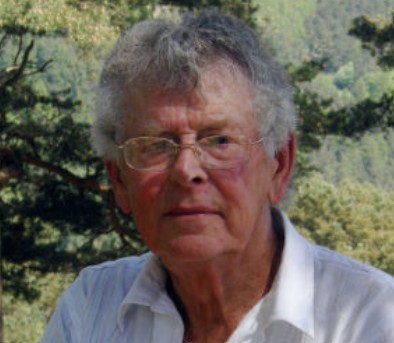
Sean Rothery
Sean Rothery (1928-2024) was a leading architect, artist, climber, orienteer, walker and prolific author. An early member of the Irish Mountaineering Club (IMC), he will be remembered for his passion for the great outdoors and Irish vernacular architecture. Born as the eldest of four children in south Dublin, within close proximity to Three Rock Mountain. He attended the local St Mary’s National School and later Synge Street Christian Brothers School. His 2018 memoir, entitled Here Come the Mountainy Men, takes its title from a remark made about him and his brother by one of the Christian Brothers on their arrival from the “countryside”. He studied architecture at University College, Dublin (UCD), undertaking cycling trips during his college years, including from Dieppe to Rome. He also took up drawing, attending night classes given by Maurice MacGonigal and Seán Keating in the National College of Art and Design. He joined Michael Scott’s architectural practice after he graduated in 1951, with the Busáras bus terminal in Dublin being one of the many projects he worked on. He was interested in rock climbing and joined the IMC in 1949, shortly after it was founded by the late Joss Lynam. A fellow member, Noel Brown, recalls his first encounter with him in Dalkey quarry in 1953, when they both shared a “great excitement”. Brown subsequently climbed with him in Ireland, in the European Alps and in Wyoming in North America, and recalls how their ice axes were made of timber with metal heads — nothing as resilient as the steel axes of today. After he swept out of the ward with his retinue scuttling after him, I said to myself, ‘Sod you, I’ll prove you wrong’ Through climbing, Sean Rothery met and married Nuala Carey who was as adept on rock faces as he was. As he wrote, “weekends were a dizzy joy” where they could “enjoy the sheer sensual pleasures of moving up a steep cliff and the fingertip texture of hard rock”. The couple married in February 1956 and moved to Uganda three months later. They learned Swahili and Sean joined the Mountain Club of Uganda. Among the many climbs he undertook was a route in the Rwenzori mountain range between Uganda and the Democratic Republic of Congo, believed to be ¬Ptolemy’s “Mountains of the Moon”. Sean described these adventures in his book, Snow on the Equator, the title alluding to the fact these mountains hosted permanent ¬glaciers. The Rotherys returned to Dublin in 1959 and had three children. Sean took up a post with the Board of Works, and then went into private practice and taught in Bolton Street. Dr Carole Pollard, one of his pupils, recalls he was “a generous teacher — energetic, enthusiastic, interesting and most importantly, interested”, but his passion for Irish vernacular architecture “was not shared by the majority of the lecturers and students in Bolton Street who were far more interested in shiny new orthogonal structures”. IMC chair Dónal Ó Murchú recalled that Sean and Nuala were climbing pioneers, with first ascents on the Far West Buttress at ¬Glendalough. Fellow mountaineer Paddy O’Leary remembers Sean as being “very encouraging”, but says he never quite got over the shock of an accident in the Swiss Alps on July 19, 1967, when he was hit by a massive rock fall and sustained serious injuries. Writing about the slow recovery in his book, A Long Walk South, he recalled a consultant telling him he wouldn’t be able to resume hill-walking. “After he swept out of the ward with his retinue scuttling after him, I said to myself, ‘Sod you, I’ll prove you wrong’.” Rothery wrote. Which he did. He took a PhD in architectural history at Trinity College, Dublin, and among his many books are Everyday Buildings of Ireland; The Shops of Ireland; Ireland and the New Architecture and A Field Guide to the Buildings of Ireland. Determined to prove retirement would always be active, he undertook a 2,300km walk from the North Sea to the Mediterranean in 1994 when he was in his 60s, the subject of A Long Walk South. He was 71 when he climbed the 5,644-metre peak, Kala Patthar, in the Nepali Himalayas. After his wife Nuala died in 2013, he was a founder, with fellow widower Peter McCabe, of the Blue Light Solo Group which met for monthly chats in the pub of the same name in Barnacullia. During Covid-19, he completed his final, as yet unpublished, book - Voices and Vision: A Life in Drawing. Source: Irish Independent
