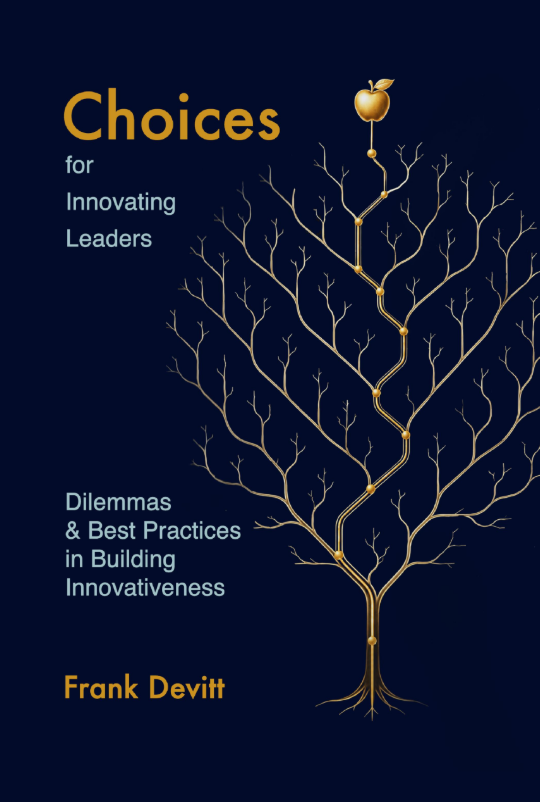
Choices for Innovating Leaders: Dilemmas & Best Practices in Building Innovativeness
| By: | Frank Devitt |
| Publisher: | Orla Kelly Publishing |
| Published: | October 2026 |
| Pages: | 204 |
| Categories: | Business |
| Language: | English |
| Available as: | Paperback |
| On sale at: |
Leading an innovation-building initiative is a lonely position. It requires managing change, but it also requires the leader to be chief arbiter of where, how and to what extent change must happen. CHOICES for Innovating Leaders – Dilemmas & Best Practices in Building Innovativeness helps innovation leaders explore some of the most intractable dilemmas that are encountered on the road to corporate innovation success. This book’s distinctive contribution is to apply a magnifying glass, across ten self-contained chapters, to a selection of common management dilemmas, from Dreaming and Doing to Macro-vision and Micromanagement and many others in between. Its aim is to equip leaders with clarity and a pragmatic outlook that will allow them to achieve a higher level of innovative performance in their organisations and to adapt with speed and agility to a rapidly changing environment. By offering an authoritative yet reflective, thoughtful and practitioner-led approach, it stands out as distinctive among today’s innovation literature. CHOICES for Innovating Leaders is an excellent companion for leaders in public and private sector organisations, whether newcomers or seasoned innovators, who wish to build innovative capacity in their teams or organisations. Each chapter provides rich supportive argumentation to help a manager negotiate diverse perspectives of the targeted topic and to make the best decisions. It also offers guidance for action without being overly prescriptive, thus helping readers to think more clearly, act more confidently, and make decisions they can justify to themselves and others. The book’s discussions are not about technology and are mostly technology agnostic. That is to say that they focus on organisational, cultural and behavioural aspects of leading innovation, all of which apply to nearly every type of business.
Other Books From this Category
-

1 Dec 2026 - Wyckham House
The Analytics System: Designing Data Foundations, Metrics, and AI for Better Business Decisions
Organizations have never had more data, dashboards, models, and artificial intelligence. Yet better decisions do not automatically follow. The Analytics System explains why. The problem is not simp...
-
31 Oct 2026 - People Brand Press
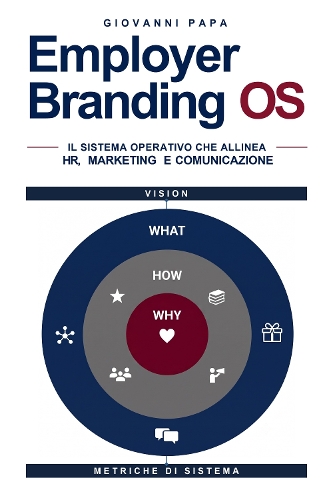
Employer Branding OS: Il sistema operativo che allinea HR, Marketing e Comunicazione
“What’s your next play after LinkedIn?” Il direttore vendite, all'ultimo colloquio del mio processo di selezione in LinkedIn Io puntavo a quel ruolo, lui mi chiedeva già cosa sarebbe venuto...
-

30 Oct 2026 - Wyckham House
The Analytics System: Designing Data Foundations, Metrics, and AI for Better Business Decisions
Organizations have never had more data, dashboards, models, and artificial intelligence. Yet better decisions do not automatically follow. The Analytics System explains why. The problem is not simp...
-

15 Oct 2026 - Wyckham House
The Analytics System: Designing Data Foundations, Metrics, and AI for Better Business Decisions
Organizations have never had more data, dashboards, models, and artificial intelligence. Yet better decisions do not automatically follow. The Analytics System explains why. The problem is not simp...
-

1 Oct 2026 - Chartered Accountants Ireland
Taxation 3 (NI) 2026–2027
Designed for the Final Admitting Examination (FAE) Proficiency 3 / Advanced Taxation course, focusing on complex tax frameworks, multi-tax interactions, and business advisory skills.
-
1 Oct 2026 - Outside the Box Learning Resources Ltd
A Climate of Mentoring: Building Teams for School Improvement
-
1 Oct 2026 - Outside the Box Learning Resources Ltd
Managing Change: Leading School Improvement
-
1 Oct 2026 - Outside the Box Learning Resources Ltd
The Power of Coaching: Nurturing Talent & Building Capacity
-
1 Oct 2026 - Outside the Box Learning Resources Ltd
Reflective Practice: The Cornerstone for School Improvement
-
1 Oct 2026 - Outside the Box Learning Resources Ltd
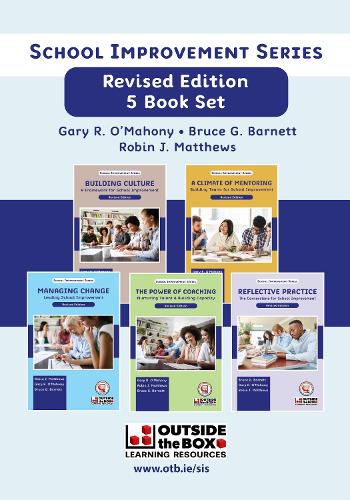
School Improvement Series (Set): Set of 5 Books
-

30 Sep 2026 - Boru Press Ltd
DIVERSITY, EQUALITY & INCLUSION IN EARLY CHILDHOOD
-

18 Sep 2026 - New Island Books
MAGILL & VINCENT BROWNE
By Kevin Rafter
Magill was the magazine that held a mirror up to Ireland at its most turbulent. In an era marked by mass unemployment, emigration, ferocious battles over abortion and divorce, and the political duels ...
-

14 Sep 2026 - Orpen Press
The Bucket Man: John Concannon and the JFC Group
“If I can start a business selling buckets, anyone can start their own business. It doesn’t matter where you come from. What matters is where you’re going, even if you’re not clear what the fi...
-
31 Aug 2026 - Chartered Accountants Ireland
Corporate Strategy
-
31 Aug 2026 - Chartered Accountants Ireland
Taxation 2 (RoI) 2026–2027
-
30 Aug 2026 - Chartered Accountants Ireland
An Introduction to Financial Accounting - 3rd Edition
This easy-to-follow textbook is a comprehensive guide for those commencing their studies in financial accounting and who want to understand the basic concepts of accounting, including the principles o...
-

26 Aug 2026 - Chartered Accountants Ireland
Taxation 1 (RoI) 2026–2027
-
22 Aug 2026 - Paul A. Synnott
A Practitioner’s Guide to Leadership in the Real World: Leading with Clarity, Courage, and Common Sense
In a world where disruption is the new normal and leadership is tested daily; theory alone is no longer enough. What truly matters is how leaders adapt, respond, and learn. Drawing on decades of hands...
-

31 Jul 2026 - Chartered Accountants Ireland
International Financial Accounting and Reporting
This seminal textbook by Ciaran Connolly, a leading academic with an extensive background in accountancy practice, is designed to provide students with the knowledge and skills to appraise underlying ...
-

27 Jul 2026 - Orpen Press
The Art of Making Millions: Get Rich, and Have Fun Doing It
By Sean Brett
The Art of Making Millions is broken into five sections. The first is all about ideas – finding the spark to light the flame. The next focuses on the need to be dogged and action-oriented. The third...
