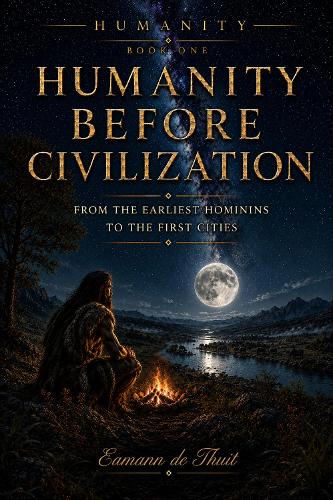
Humanity Before Civilization: From the Earliest Hominins to the First Cities
| By: | Eamann de Thuit |
| Publisher: | Humanity Series Publishing |
| Published: | August 2026 |
| Pages: | 362 |
| Categories: | Earth Sciences, Non-Fiction, Science |
| Language: | English |
| Available as: | Hardback, Paperback, Audio |
| On sale at: |
We are not the end of a staircase. We are the survivors of a narrowing path. Seven million years ago, something stood upright at the edge of a shrinking African lake. It was not human. It was not an ape. It was the first step in an experiment that would eventually produce at least eight different human species — and let only one of them survive. Humanity Before Civilization is the story of everyone who came before the first city: the upright apes, the fire-keepers, the cave-dwellers, the ice-walkers, the lost cousins whose bones we are only now learning to read. It is a sweeping, evidence-driven journey through seven million years of human evolution — from Toumaï and Ardi to Neanderthals and Denisovans, from the mammoth steppe to Göbekli Tepe, from the last Ice Age to the first grain fields of Mesopotamia. This is not a textbook march of progress. It is a family history — violent, scattered, brilliant, and fragile — told through the fossils, genomes, footprints, and flooded landscapes that survive us. You will meet: — Toumaï and Ardi, the improbable first walkers, and the collapse of the "savannah hypothesis" that once explained why we stand upright — Homo erectus, the most successful human species that ever lived, who endured for nearly two million years and crossed continents on foot — Homo naledi, small-brained cave explorers who may have deliberately placed their dead in total darkness deep underground — The Denisovans, an entire branch of humanity discovered only in 2010 — from a single fingertip bone — who still shape the immune systems and high-altitude survival of people alive today — The Neanderthals, who built mysterious ring structures three hundred meters underground, cared for their wounded into old age, and live on in the DNA of every non-African person on Earth — The Ice Age hunters who survived the coldest millennia in human memory, and the controversial evidence for a catastrophic comet impact at the end of the last Ice Age — Göbekli Tepe, the astonishing 11,000-year-old sanctuary that suggests religion may have come before farming, not after it — The first villages of Mesopotamia, where humanity began trading freedom for grain, and the long, difficult transition into the world we now call civilization Drawing on paleoanthropology, ancient DNA research, climate science, and archaeology — and engaging honestly with both mainstream consensus and the more contested debates around catastrophism and the Younger Dryas — this book restores the strangeness, danger, and wonder of the world before history began. It does not offer a tidy story of inevitable human triumph. It offers something more honest: a species that survived by a thread, absorbed the biology of the cousins it replaced, and is still, in every measurable way, carrying the dead within the living. If you've ever wondered what came before the pyramids, before writing, before cities — before us, in the sense we usually mean — this is where that story begins. For readers of Sapiens, The Dawn of Everything, and Graham Hancock's explorations of the deep past, Humanity Before Civilization is a rigorously researched, richly narrated account of the seven-million-year journey that made civilization possible — and nearly didn't happen at all.
Other Books From this Category
-

27 May 2027 - Gill
The Accidental Peacekeeper: Witness, War and the Weight of Being There
AN IRISH SOLDIER’S JOURNEY THROUGH THE FRONTLINES AND FAULT LINES OF THE TWENTY-FIRST CENTURY ‘I should never have been in any of these places. I should have been an English teacher in Nort...
-
13 May 2027 - Nine Bean Rows Books
Masaalchi: A Punk Spice Manifesto
By Arun Kapil
This is not a conventional cookbook, and it’s not a food memoir either. It’s a punk masaalchi’s kitchen manifesto: a book about flavour, instinct, rhythm and confidence. Arun Kapil looks at foo...
-
22 Apr 2027 - Nine Bean Rows Books
Smokin' Soul: The Essentials of Live-Fire Cooking: Volume 22
Fire is the oldest cooking tool we have. Long before kitchens, thermometers, recipes or even salt, there was fire and the understanding of how to live with it. Pat Conway and Jim O’Brien build fire...
-
1 Apr 2027 - Merrion Press
Revelations: Jeffrey Donaldson: Politician, Preacher, Predator
-
4 Mar 2027 - Nine Bean Rows Books
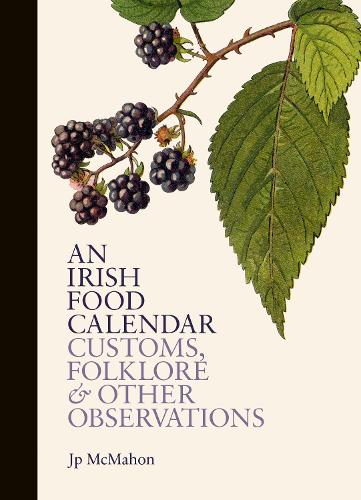
An Irish Food Calendar: Customs, Folklore and Other Observations
By Jp McMahon
An Irish Food Calendar explores the traditions, stories and seasonal rhythms that have shaped Ireland's culinary identity. Travelling through the Irish year, it uncovers forgotten customs alongside en...
-
26 Feb 2027 - Four Courts Press Ltd
Noyk: Legal advisor to Michael Collins
By Barry Whelan
-
26 Feb 2027 - Four Courts Press Ltd
Prehistoric Art in Ireland
By John Waddell
-

12 Feb 2027 - Lonely Planet Global Limited
Lonely Planet Kids The Ultimate Book of Travel Activities
The ultimate on-the-go activity book for travel-loving kids who enjoy pen to paper activities. From crossword puzzles to word searches; hidden pictures to join-the-dots; The Ultimate Book of Travel A...
-

12 Feb 2027 - Lonely Planet Global Limited
Lonely Planet Pocket Valencia
Discover twice the city in half the time with our expert team of travel writers who share what you need to know to plan the ultimate short trip to Valencia. Imagine a place where a 100-year old resta...
-

12 Feb 2027 - Lonely Planet Global Limited
Lonely Planet Pocket Philadelphia
Discover twice the city in half the time with our expert team of travel writers who share what you need to know to plan the ultimate short trip to Philadelphia. Imagine a place where a melting pot of...
-

12 Feb 2027 - Lonely Planet Global Limited
Lonely Planet Pocket Algarve
Discover twice the place in half the time with our expert team of travel writers who share what you need to know to plan the ultimate short trip to the Algarve. Imagine a place where a hinterland of ...
-

12 Feb 2027 - Lonely Planet Global Limited
Lonely Planet Pocket Bilbao & San Sebastian
Discover twice the place in half the time with our expert team of travel writers who share what you need to know to plan the ultimate short trip to Bilbao & San Sebastian. Imagine a place where cutti...
-
12 Feb 2027 - Lonely Planet Global Limited
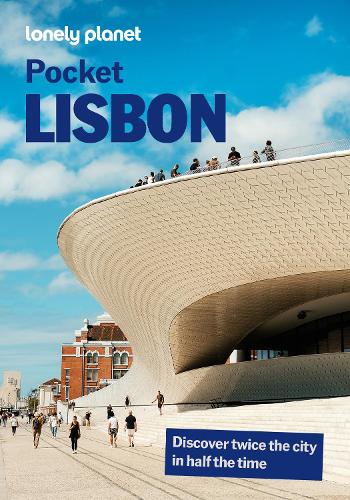
Lonely Planet Pocket Lisbon: Detailed Itineraries | Travel Like a Local | Insider Tips | Covers Bairro Alto, Castelo, Belém, Parque das Nações and more
Discover twice the city in half the time with our expert team of travel writers who share what you need to know to plan the ultimate short trip to Lisbon. Imagine a place where simple seafood suppers...
-
12 Feb 2027 - Lonely Planet Global Limited
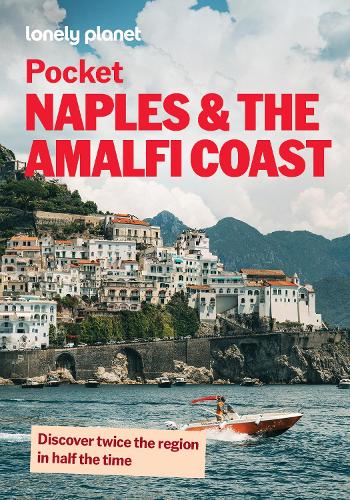
Lonely Planet Pocket Naples & the Amalfi Coast: Detailed Itineraries | Travel Like a Local | Insider Tips | Covers Centro Storico, Toledo, Capodimonte and more
Discover twice the place in half the time with our expert team of travel writers who share what you need to know to plan the ultimate short trip to Naples & the Amalfi Coast. Imagine a place where ja...
-
12 Feb 2027 - Lonely Planet Global Limited
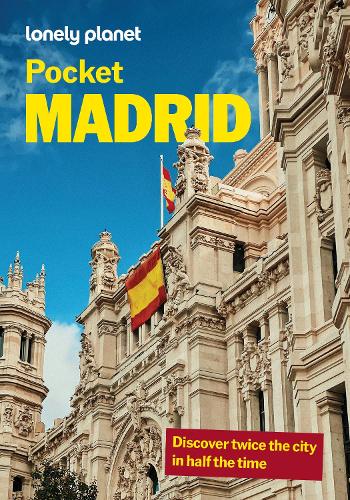
Lonely Planet Pocket Madrid
Discover twice the city in half the time with our expert team of travel writers who share what you need to know to plan the ultimate short trip to Madrid. Imagine a place where talented artisans weav...
-

12 Feb 2027 - Lonely Planet Global Limited
Lonely Planet Pocket Milan: Detailed Itineraries | Travel Like a Local | Insider Tips | Covers Parco Sempione, Porta Garibaldi, Brera, Duomo, Navigli, and more
Discover twice the city in half the time with our expert team of travel writers who share what you need to know to plan the ultimate short trip to Milan. Imagine a place where medieval fortresses hou...
-
12 Feb 2027 - Lonely Planet Global Limited
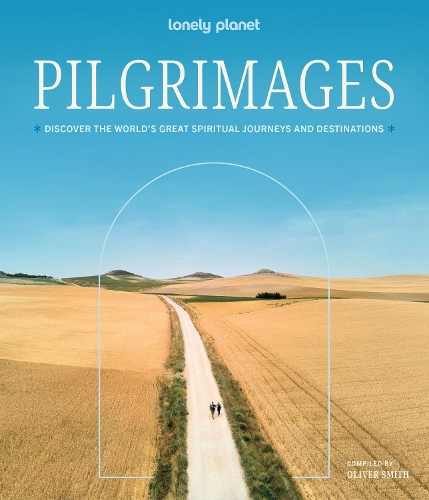
Lonely Planet Pilgrimages: Discover the World’s Great Spiritual Journeys and Destinations
Discover more than 50 of the world's great pilgrimages and spiritual destinations and get all the inspiration you need to plan your next enlightening journey. Make time for self-reflection while tre...
-

12 Feb 2027 - Lonely Planet Global Limited
Lonely Planet Pocket Genoa & Cinque Terre
Discover twice the place in half the time with our expert team of travel writers who share what you need to know to plan the ultimate short trip to Genoa & Cinque Terre. Imagine a place where stunnin...
-
5 Feb 2027 - Orpen Press
A Woman of Honour
-

22 Jan 2027 - Cairn Portal Press
The Spiritual Journey Home: From Being Human to Spiritual Being ; An Irish Shaman's Answer to What's it All About
